---
✅ Meaning of Decentralization
Decentralization refers to the systematic delegation of authority from the top management to the middle and lower levels in the organizational hierarchy. It involves distributing decision-making powers across various levels and departments within an organization.
---
✅ Definition of Decentralization
> Louis A. Allen:
“Decentralization is the systematic delegation of authority throughout all the levels of the organization.”
> Koontz and O’Donnell:
“Decentralization is a fundamental decision to push authority down the organizational hierarchy.”
---
✅ Decentralization as an Extension of Delegation
While delegation is the act of assigning specific responsibilities and authority from a superior to a subordinate, decentralization is a broader concept. It is an institutional arrangement where decision-making powers are pushed down to lower levels in the organization permanently and systematically.
---
✅ Advantages of Decentralization
1. Quick Decision-Making
Local units or lower-level managers can respond promptly to changes.
2. Managerial Development
Encourages leadership and responsibility at multiple levels.
3. Better Control and Supervision
Local managers have closer oversight of operations.
4. Relieves Top Management
Frees top executives to focus on strategic issues.
5. Improved Motivation and Morale
Empowered employees feel more valued and engaged.
---
✅ Disadvantages of Decentralization
1. Coordination Issues
Difficult to maintain consistency across all units.
2. Duplication of Efforts
Resources and tasks may be unnecessarily repeated.
3. Higher Costs
More managers and support systems increase expenses.
4. Risk of Conflict
Local vs. central interests can clash.
---
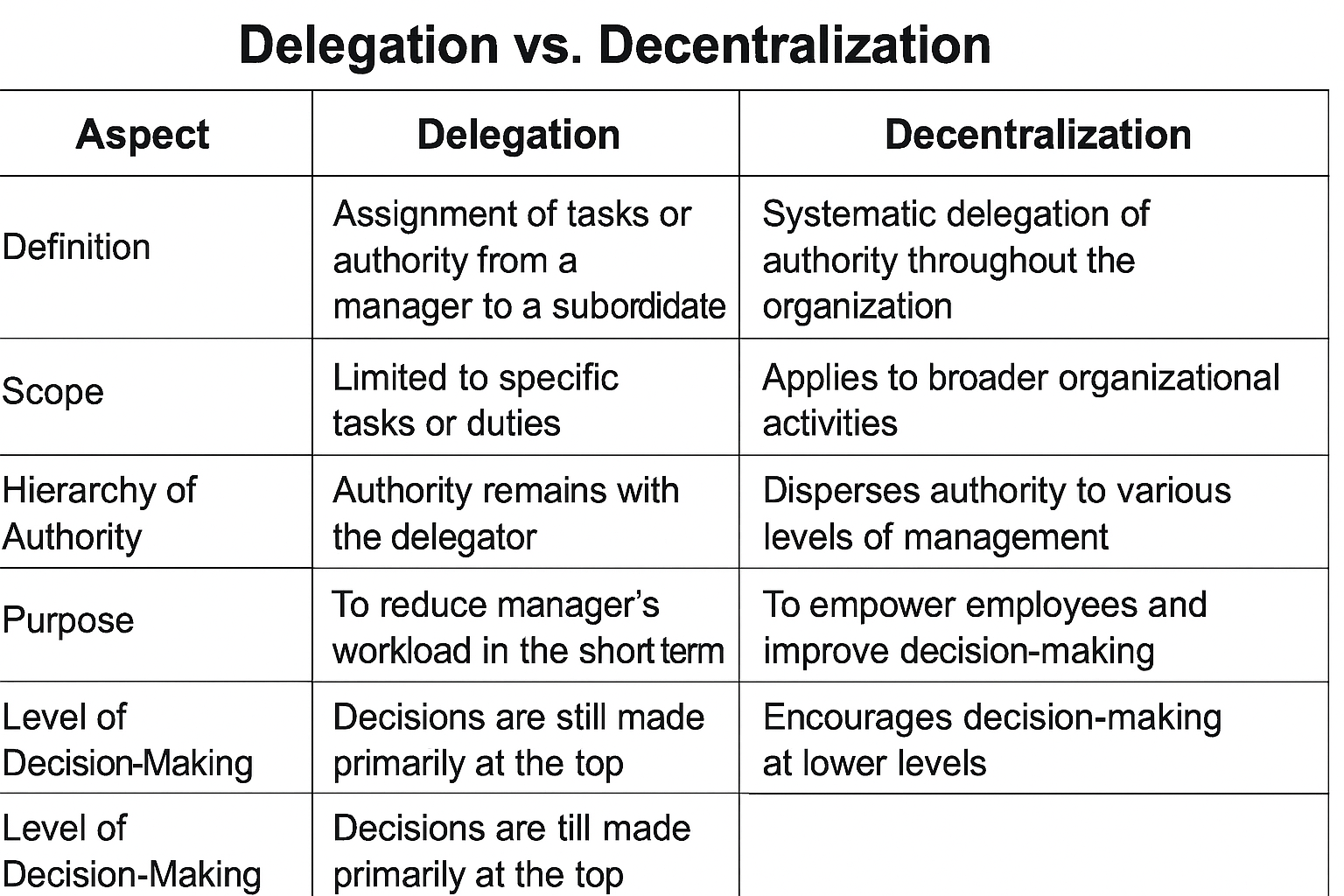
✅ Comparison: Delegation vs. Decentralization
Feature Delegation Decentralization
Scope Individual, task-based Organization-wide, strategic
Control Superior retains control Independent authority at lower levels
Responsibility Accountability remains with delegator Responsibility is shared
Flexibility Temporary or as-needed Permanent structural approach
Decision Making Centralized in the superior Decision power is spread across levels
---
✅ (Image Coming Next)
I'll create a visual table comparing Delegation vs. Decentralization in the next message.
---
✅ Methods and Patterns of Decentralization
1. Geographical Decentralization
Separate authority for regional units.
2. Functional Decentralization
Departments like HR, Marketing, and Finance have autonomous decision-making.
3. Divisional Decentralization
Product or service-based divisions operate semi-independently.
4. Customer-based Decentralization
Teams are formed based on types of customers (e.g., B2B, B2C).
---
✅ Methods to Make Centralization More Effective
1. Strong Leadership
Centralized decision-making works best with visionary leadership.
2. Effective Communication Channels
Ensures orders and updates are accurately passed down.
3. Use of Technology
MIS and ERP systems make centralized control efficient.
4. Clear Organizational Structure
Define roles and reporting relationships to avoid confusion.
5. Periodic Review & Feedback
Ensures adaptability even under centralized systems.